Ultrafine Particles (UFPs)
What Are Ultrafine Particles?
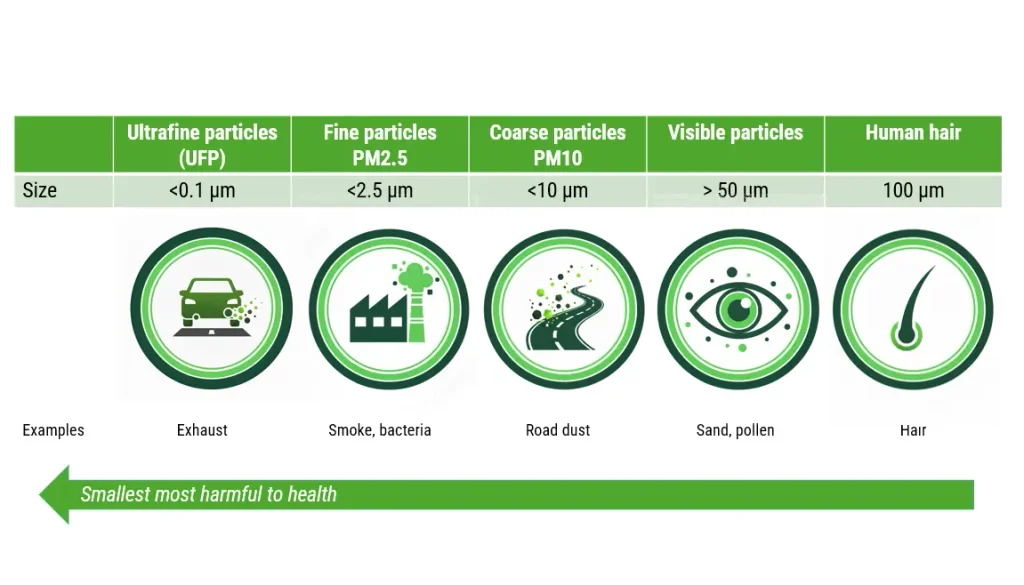
Ultrafine particles (UFPs) are generally considered to be particles smaller than 100 nm. In practice, particle number measurements often focus on particles larger than 10 nm, reflecting current monitoring standards and regulatory requirements. For comparison, a human hair is approximately 70,000-100,000 nm thick.
Despite their tiny size, ultrafine particles often account for the vast majority of particles present in the air. Because they are so small, they contribute very little to the total particle mass measured by conventional air quality metrics.
As a result, air can appear clean and PM2.5 concentrations can remain low while the number of ultrafine particles is extremely high.
Why Are Ultrafine Particles Important?
Traditional air quality monitoring focuses on particle mass metrics such as:
- PM10 – mass of particles smaller than 10 µm
- PM2.5- mass of particles smaller than 2.5 µm
- PM1- mass of particles smaller than 1 µm
These measurements are valuable and widely used. However, they may not fully capture exposure to ultrafine particles because individual UFPs are so small that they contribute only a tiny amount of mass.
As a result:
- High particle numbers can exist alongside low PM2.5 values.
- Particle mass and particle number may not correlate well.
- Important aerosol events can be missed if only mass concentrations are monitored.
For a more complete understanding of airborne particles, many researchers and air quality professionals use both mass-based and number-based measurements.
Sources of Ultrafine Particles
Ultrafine particles are produced by a variety of natural and human-made sources, including:
- Vehicle exhaust emissions
- Residential wood burning
- Industrial processes
- Power generation
- Aircraft emissions
- Cooking activities
- Atmospheric particle formation processes
In urban environments, road traffic is often a major source of ultrafine particles.
Particle Number vs. Particle Mass
A key concept in aerosol science is the difference between particle mass and particle number.
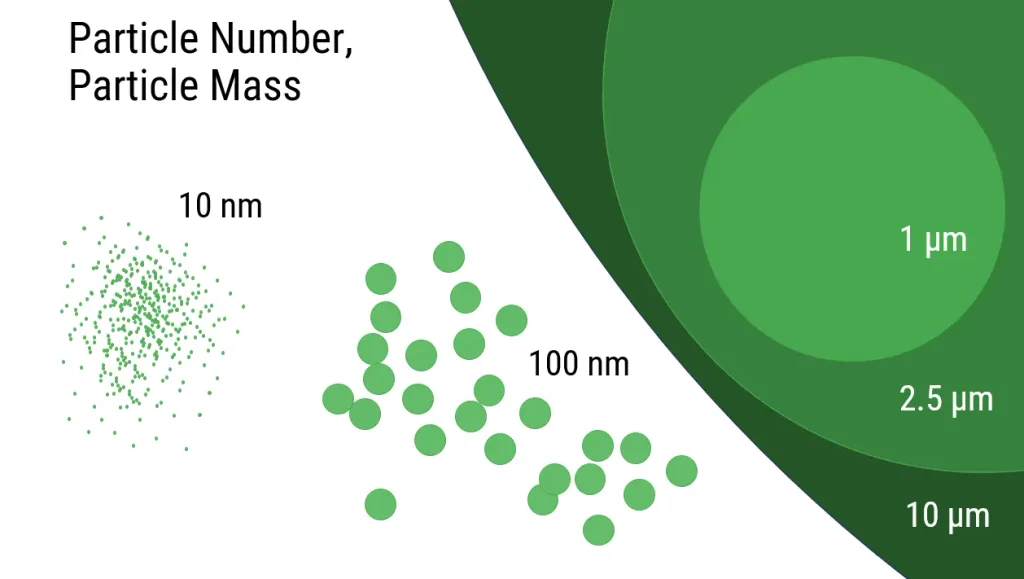
Particle mass measurements indicate how much particulate matter is present in the air. Particle number measurements indicate how many particles are present.
Because ultrafine particles are extremely small, they contribute very little to total particle mass. However, they can exist in very large numbers.
This means that two locations may show similar PM2.5 concentrations while having dramatically different particle number concentrations. In some cases, air with relatively low PM2.5 levels may still contain tens of thousands of ultrafine particles per cubic centimetre.
For this reason, particle number concentration (PNC) is increasingly used alongside traditional PM measurements to provide a more complete understanding of air quality and particle emissions.
Where Is UFP Monitoring Used?
Ultrafine particle monitoring is used in a wide range of applications, including:
- Ambient air quality monitoring
- Urban pollution studies
- Occupational exposure assessments
- Indoor air quality investigations
- Combustion process monitoring
- Engine and vehicle emissions testing
- Cleanroom monitoring
- Industrial process monitoring
Why Are Ultrafine Particles Receiving Increased Attention?
Ultrafine particles are receiving growing attention from researchers, health organizations, and regulators due to their unique characteristics.
Because of their extremely small size, ultrafine particles can penetrate deep into the respiratory system. Their high surface area relative to their mass also means they can carry a variety of chemical compounds.
Research has linked exposure to elevated concentrations of ultrafine particles with a range of potential health concerns, particularly in urban environments where traffic and combustion sources may contribute significantly to particle numbers.
While most air quality regulations continue to focus on mass-based metrics such as PM2.5 and PM10, there is increasing scientific interest in understanding the role of particle number concentration and ultrafine particle exposure in public health.
As a result, interest in ultrafine particle monitoring continues to grow worldwide.
Learn More
Interested in ultrafine particle monitoring and particle number concentration measurement?
Explore our related resources: